The Catcher in the Rye
Holden Caulfield
The protagonist and narrator of the novel, Holden is a sixteen-year-old junior who has just been expelled for academic failure from a school called Pencey Prep. Although he is intelligent and sensitive, Holden narrates in a cynical and jaded voice. He finds the hypocrisy and ugliness of the world around him almost unbearable, and through his cynicism he tries to protect himself from the pain and disappointment of the adult world. However, the criticisms that Holden aims at people around him are also aimed at himself. He is uncomfortable with his own weaknesses, and at times displays as much phoniness, meanness, and superficiality as anyone else in the book. As the novel opens, Holden stands poised on the cliff separating childhood from adulthood. His inability to successfully negotiate the chasm leaves him on the verge of emotional collapse.

Ackley
Holden’s next-door neighbor in his dorm at Pencey Prep. Ackley is a pimply, insecure boy with terrible dental hygiene. He often barges into Holden’s room and acts completely oblivious to Holden’s hints that he should leave. Holden believes that Ackley makes up elaborate lies about his sexual experience.
Phoebe Caulfield
Phoebe is Holden’s ten-year-old sister, whom he loves dearly. Although she is six years younger than Holden, she listens to what he says and understands him more than most other people do. Phoebe is intelligent, neat, and a wonderful dancer, and her childish innocence is one of Holden’s only consistent sources of happiness throughout the novel. At times, she exhibits great maturity and even chastises Holden for his immaturity. Like Mr. Antolini, Phoebe seems to recognize that Holden is his own worst enemy.
Allie Caulfield
Holden’s younger brother. Allie dies of leukemia three years before the start of the novel. Allie was a brilliant, friendly, red-headed boy—according to Holden, he was the smartest of the Caulfields. Holden is tormented by Allie’s death and carries around a baseball glove on which Allie used to write poems in green ink.
Mr. Antolini
Holden’s former English teacher at the Elkton Hills School. Mr. Antolini now teaches at New York University. He is young, clever, sympathetic, and likable, and Holden respects him. Holden sometimes finds him a bit too clever, but he looks to him for guidance. Like many characters in the novel, he drinks heavily.
Proletarian literature
Proletarian literature refers here to the literature created by working-class writers mainly for the class-conscious proletariat. Though the Encyclopædia Britannica states that because it "is essentially an intended device of revolution", it is therefore often published by the Communist Party or left wing sympathizers, the proletarian novel has also been categorized without any emphasis on revolution, as a novel "about the working classes and working-class life; perhaps with the intention of making propaganda". This different emphasis may reflect a difference between Russian, American and other traditions of working-class writing, with that of Britain. The British tradition was not especially inspired by the Communist Party, but had its roots in the Chartist movement, and socialism, amongst others. Furthermore, writing about the British working-class writers, H Gustav Klaus, in The Socialist Novel: Towards the Recovery of a Tradition (1982) suggested that "the once current [term] 'proletarian' is, internationally, on the retreat, while the competing concepts of 'working-class' and 'socialist' continue to command about equal adherence".
Tuberculosis
Tuberculosis (TB) is an infectious disease caused by the bacterium Mycobacterium tuberculosis (MTB).Tuberculosis generally affects the lungs, but can also affect other parts of the body. Most infections do not have symptoms, in which case it is known as latent tuberculosis. About 10% of latent infections progress to active disease which, if left untreated, kills about half of those infected. The classic symptoms of active TB are a chronic cough with blood-containing sputum, fever, night sweats, and weight loss.The historical term "consumption" came about due to the weight loss. Infection of other organs can cause a wide range of symptoms.
Detective fiction
Detective fiction is a subgenre of crime fiction and mystery fiction in which an investigator or a detective—either professional or amateur—investigates a crime, often murder.Edqar Allan Poe
Edgar Allan Poe (/poʊ/; born Edgar Poe; January 19, 1809 – October 7, 1849) was an American writer, editor, and literary critic. Poe is best known for his poetry and short stories, particularly his tales of mystery and the macabre. He is widely regarded as a central figure of Romanticism in the United States and American literature as a whole, and he was one of the country's earliest practitioners of the short story. Poe is generally considered the inventor of the detective fiction genre and is further credited with contributing to the emerging genre of science fiction. He was the first well-known American writer to try to earn a living through writing alone, resulting in a financially difficult life and career.
Sherlock Holmes
Sherlock Holmes (/ˈʃɜːrlɒk ˈhoʊmz/) is a fictional private detective created by British author Sir Arthur Conan Doyle. Known as a "consulting detective" in the stories, Holmes is known for a proficiency with observation, forensic science, and logical reasoning that borders on the fantastic, which he employs when investigating cases for a wide variety of clients, including Scotland Yard.

John H. Watson
John H. Watson, known as Dr. Watson, is a fictional character in the Sherlock Holmes stories by Sir Arthur Conan Doyle and was the narrator in the original stories. Watson is Sherlock Holmes's friend, assistant and sometime flatmate, and the first person narrator of all but four of these stories. He is described as the typical Victorian-era gentleman, unlike the more eccentric Holmes. He is astute, although he can never match his friend's deductive skills.

221B Baker Street
221B Baker Street is the London address of the fictional detective Sherlock Holmes, created by author Sir Arthur Conan Doyle. In the United Kingdom, postal addresses with a number followed by a letter may indicate a separate address within a larger, often residential building. Baker Street in Holmes' time was a high-class residential district, and Holmes' apartment was probably part of a Georgianterrace.


Arthur Conan Doyle
Sir Arthur Ignatius Conan Doyle KStJ, DL (22 May 1859 – 7 July 1930) was a British writer and physician, most noted for his character Sherlock Holmes and his detective fiction, which are generally considered milestones in the field of crime fiction.

Angela Lansbury
Dame Angela Brigid Lansbury, DBE (born 16 October 1925) is a British-American-Irish actress who has appeared in theatre, television and film. Her career has spanned seven decades, much of it in the United States, and her work has attracted international attention.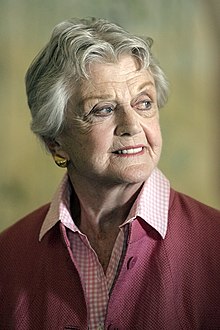
Murder, She Wrote
Murder, She Wrote is an American crime drama television series starring Angela Lansbury as mystery writer and amateur detective Jessica Fletcher. The series aired for 12 seasons with 264 episodes from 1984 to 1996 on the CBS network. It was followed by four TV films and an unsuccessful spin-off series, which was produced in 1987, The Law & Harry McGraw. It is one of the most successful and longest-running television shows in history, averaging close to 26 million viewers per week in its prime, and was a staple of the CBS Sunday night lineup for a decade. In syndication, the series is still highly successful throughout the world.

Charles Dickens
Charles John Huffam Dickens (/ˈdɪkᵻnz/; 7 February 1812 – 9 June 1870) was an English writer and social critic. He created some of the world's best-known fictional characters and is regarded by many as the greatest novelist of the Victorian era. His works enjoyed unprecedented popularity during his lifetime, and by the twentieth century critics and scholars had recognised him as a literary genius. His novels and short stories enjoy lasting popularity.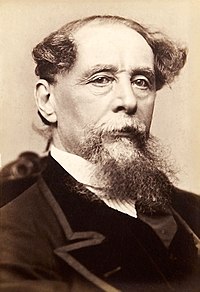

A Christmas Carol
A Christmas Carol in Prose, Being a Ghost-Story of Christmas, commonly known as A Christmas Carol, is a novella by Charles Dickens, first published in London by Chapman & Hall in 1843. A Christmas Carol tells the story of Ebenezer Scrooge, an old miser who is visited by the ghost of his former business partner Jacob Marley and the Ghosts of Christmas Past, Present and Yet to Come. After their visits Scrooge is transformed into a kinder, gentler man.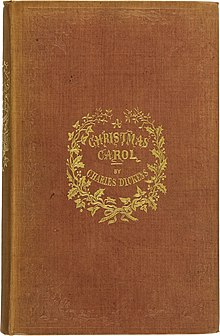


A Tale of Two Cities
A Tale of Two Cities (1859) is a novel by Charles Dickens, set in London and Paris before and during the French Revolution. The novel depicts the plight of the French peasantry demoralized by the French aristocracy in the years leading up to the revolution, the corresponding brutality demonstrated by the revolutionaries toward the former aristocrats in the early years of the revolution, and many unflattering social parallels with life in London during the same period.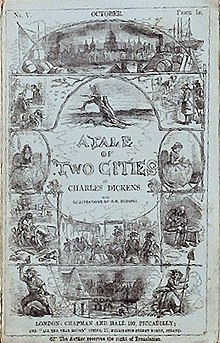

Stream of conscious
In literary criticism, stream of consciousness is a narrative mode or method that attempts to depicts the multitudinous thoughts and feelings which pass through the mind.The term was coined by William James in 1890 in his The Principles of Psychology, and in 1918 the novelist May Sinclair (1863–1946) first applied the term stream of consciousness, in a literary context, when discussing Dorothy Richardson's (1873–1957) novels. Pointed Roofs (1915), the first work in Richardson's series of 13 semi-autobiographical novels titled Pilgrimage, is the first complete stream of consciousness novel published in English. However, in 1934, Richardson comments that "Proust, James Joyce, Virginia Woolf & D.R. ... were all using 'the new method', though very differently, simultaneously".Chivalric romance
As a literary genre of high culture, romance or chivalric romance is a type of prose and verse narrative that was popular in the aristocratic circles of High Medieval and Early Modern Europe. They were fantastic stories about marvel-filled adventures, often of a knight-errant portrayed as having heroic qualities, who goes on a quest, yet it is "the emphasis on love and courtly manners distinguishes it from the chanson de geste and other kinds of epic, in which masculine military heroism predominates." Popular literature also drew on themes of romance, but with ironic, satiric or burlesque intent. Romances reworked legends, fairy tales, and history to suit the readers' and hearers' tastes, but by c. 1600 they were out of fashion, and Miguel de Cervantes famously burlesqued them in his novel Don Quixote. Still, the modern image of "medieval" is more influenced by the romance than by any other medieval genre, and the word medieval evokes knights, distressed damsels, dragons, and other romantic tropes.

Courtly love
Courtly love (or fin'amor in Occitan) was a medieval European literary conception of love that emphasized nobility and chivalry. Medieval literature is filled with examples of knights setting out on adventures and performing various services for ladies because of their "courtly love". This kind of love is originally a literary fiction created for the entertainment of the nobility, but as time passed, these ideas about love changed and attracted a larger audience. In the high Middle Ages, a "game of love" developed around these ideas as a set of social practices. "Loving nobly" was considered to be an enriching and improving practice.
Chiralry
Chivalry, or the chivalric code, is a code of conduct associated with the medieval institution of knighthood which developed between 1170 and 1220. The ideals of chivalry were popularized in medieval literature, especially the Matter of Britain and Matter of France, the former based on Geoffrey of Monmouth's Historia Regum Britanniae which introduced the legend of King Arthur, written in the 1130s.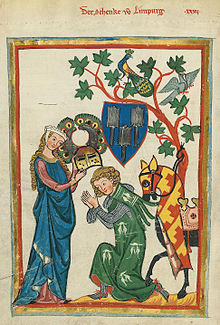
Brave New World
Brave New World is a novel written in 1931 by Aldous Huxley, and published in 1932. Set in London in the year AD 2540 (632 A.F.—"After Ford"—in the book), the novel anticipates developments in reproductive technology, sleep-learning, psychological manipulation, and classical conditioning that are combined to profoundly change society. Huxley answered this book with a reassessment in an essay, Brave New World Revisited (1958), and with Island (1962), his final novel.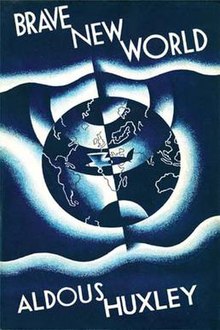


沒有留言:
張貼留言