The Catcher in the Rye Quotes
“Don't ever tell anybody anything. If you do, you start missing everybody.”
― J.D. Salinger, The Catcher in the Rye
― J.D. Salinger, The Catcher in the Rye
When Holden makes this statement, he means that once you get close to someone and depend on them for emotional support and you have a real connection, you can really miss that person, because they can leave you. People leave, they die, they are unreliable.
“The mark of the immature man is that he wants to die nobly for a cause, while the mark of the mature man is that he wants to live humbly for one.”
― J.D. Salinger, The Catcher in the Rye
― J.D. Salinger, The Catcher in the Rye
“I'd just be the catcher in the rye and all. I know it's crazy, but that's the only thing I'd really like to be. I know it's crazy.”
― J.D. Salinger, The Catcher in the Rye
― J.D. Salinger, The Catcher in the Rye
Even more nobly, Holden doesn't just want to "save guys' lives," he wants to save kids' lives.
“Grand. There's a word I really hate. It's a phony. I could puke every time I hear it.”
― J.D. Salinger, The Catcher in the Rye
― J.D. Salinger, The Catcher in the Rye
The Hooding Ceremony
The Hooding Ceremony is an event whereby recognition is given for those graduating with doctoral degrees. These individuals are doctoral candidates and will be full receipents of their doctorates at the graduation ceremonies. The Hooding Ceremony is symbolic of passing the guard from one generation of doctors to the next generation of doctors. During the ceremony a faculty advisor or Dean of the Graduate School place the doctoral hood over the head of the graduate, signifying his or her success in completing the graduate program. The ceremony is similar to a graduation in that faculty and students are dressed in academic attire. The Hooding Ceremony is in addition to and does not replace the Graduation Exercises.

Manchester by the Sea
Manchester by the Sea is a 2016 American drama film written and directed by Kenneth Lonergan and starring Casey Affleck, Michelle Williams, Kyle Chandler, and Lucas Hedges. The plot follows a man who looks after his teenage nephew after his brother dies.
The film premiered at the Sundance Film Festival on January 23, 2016 and was soon picked up by Amazon Studios for distribution. It began a limited release on November 18, 2016, before going wide on December 16, 2016, and grossed $72 million worldwide on an $8.5 million budget.


website: https://www.youtube.com/watch?v=u2LkLG0j1-Q
Charon
In Greek mythology, Charon or Kharon (/ˈkɛərɒn/ or /ˈkɛərən/; Greek Χάρων) is the ferryman of Hades who carries souls of the newly deceased across the rivers Styx and Acheron that divided the world of the living from the world of the dead. A coin to pay Charon for passage, usually an obolus or danake, was sometimes placed in or on the mouth of a dead person.[1] Some authors say that those who could not pay the fee, or those whose bodies were left unburied, had to wander the shores for one hundred years. In the catabasis mytheme, heroes – such as Aeneas, Dionysus, Heracles, Hermes, Odysseus, Orpheus, Pirithous, Psyche, Theseus and Sisyphus – journey to the underworld and return, still alive, conveyed by the boat of Charon.

Araby

FIB
Focused ion beam, also known as FIB, is a technique used particularly in the semiconductor industry, materials science and increasingly in the biological field for site-specific analysis, deposition, and ablation of materials. A FIB setup is a scientific instrument that resembles a scanning electron microscope (SEM). However, while the SEM uses a focused beam of electrons to image the sample in the chamber, a FIB setup uses a focused beam of ions instead. FIB can also be incorporated in a system with both electron and ion beam columns, allowing the same feature to be investigated using either of the beams. FIB should not be confused with using a beam of focused ions for direct write lithography (such as in proton beam writing). These are generally quite different systems where the material is modified by other mechanisms.

boarding school
A boarding school is a school at which most or all of the students live during the part of the year that they go to lessons. The word 'boarding' is used in the sense of "bed and board," i.e., lodging and meals. Some boarding schools also have day students who attend the institution by day and return to their families in the evenings.

university-preparatory school
A university-preparatory school or college-preparatory school (shortened to preparatory school, prep school, or college prep) is a type of secondary school. The term can refer to public, private independent or parochial schools primarily designed to prepare students for higher education.
Epiphany
An epiphany (from the ancient Greek ἐπιφάνεια, epiphaneia, "manifestation, striking appearance") is an experience of sudden and striking realization. Generally the term is used to describe scientific breakthrough, religious or philosophical discoveries, but it can apply in any situation in which an enlightening realization allows a problem or situation to be understood from a new and deeper perspective. Epiphanies are studied by psychologists and other scholars, particularly those attempting to study the process of innovation.
Gravity
Gravity, or gravitation, is a natural phenomenon by which all things with mass are brought toward (or gravitate toward) one another, including planets, stars and galaxies. Since energy and mass are equivalent, all forms of energy, including light, also cause gravitation and are under the influence of it. On Earth, gravity gives weight to physical objects and causes the ocean tides. The gravitational attraction of the original gaseous matter present in the Universe caused it to begin coalescing, forming stars – and the stars to group together into galaxies – so gravity is responsible for many of the large scale structures in the Universe. Gravity has an infinite range, although its effects become increasingly weaker on farther objects.


checkmate
Checkmate (often shortened to mate) is a game position in chess and other chess-like games in which a player's king is in check (threatened with capture) and there is no way to remove the threat. Checkmating the opponent wins the game.

graffiti
Graffiti (plural of graffito: "a graffito", but "these graffiti") are writing or drawings that have been scribbled, scratched, or painted illicitly on a wall or other surface, often within public view. Graffiti range from simple written words to elaborate wall paintings, and they have existed since ancient times, with examples dating back to Ancient Egypt, Ancient Greece, and the Roman Empire.


Douglas MacArthur
Douglas MacArthur (26 January 1880 – 5 April 1964) was an American five-star general and field marshal of the Philippine Army. He was Chief of Staff of the United States Army during the 1930s and played a prominent role in the Pacific theater during World War II. He received the Medal of Honor for his service in the Philippines Campaign, which made him and his father Arthur MacArthur, Jr., the first father and son to be awarded the medal. He was one of only five men ever to rise to the rank of General of the Army in the US Army, and the only man ever to become a field marshal in the Philippine Army.
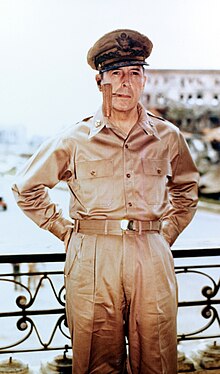

Editor’s note: While General Douglas MacArthur was stationed in Australia and acting as Supreme Commander of Allied Forces in the Southwest Pacific Area, he penned this prayer for his only son, Arthur.
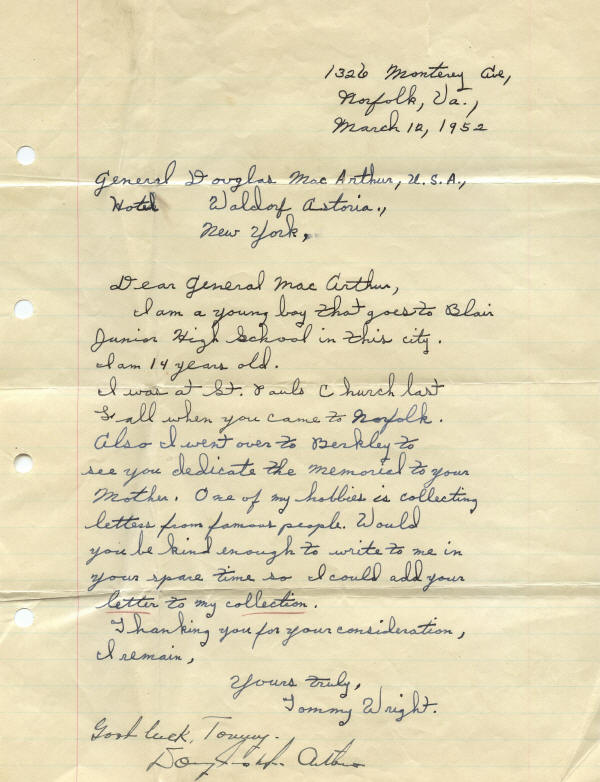
Samuel Ullman
Samuel Ullman (April 13, 1840 – March 21, 1924) was an American businessman, poet, humanitarian. He is best known today for his poem Youth[1] which was a favorite of General Douglas MacArthur. The poem was on the wall of MacArthur's office in Tokyo when he became Supreme Allied Commander in Japan. In addition, MacArthur often quoted from the poem in his speeches, leading to it becoming better known in Japan than in the United States.

alliteration
Alliteration is a stylistic literary device identified by the repeated sound of the first letter in a series of multiple words, or the repetition of the same letter sounds in stressed syllables of a phrase. "Alliteration" is from the Latin word littera, meaning "letter of the alphabet", and the first known use of the word to refer to a literary device occurred around 1624. Alliteration narrowly refers to the repetition of a letter in any syllables that, according to the poem's meter, are stressed, as in James Thomson's verse "Come…dragging the lazy languid Line along". Another example is "Peter Piper picked a peck of pickled peppers".

沒有留言:
張貼留言