Health care in the United States
Health care in the United States is provided by many distinct organizations. Health care facilities are largely owned and operated by private sector businesses. 58% of US community hospitals are non-profit, 21% are government owned, and 21% are for-profit.According to the World Health Organization (WHO), the United States spent more on health care per capita ($8,608), and more on health care as percentage of its GDP (17%), than any other nation in 2011.


Creepy
Creepy was an American horror-comics magazine launched by Warren Publishing in 1964. Like Mad, it was a black-and-white newsstand publication in a magazine format and thus did not require the approval or seal of the Comics Code Authority. The anthology magazine was initially published quarterly but later went bimonthly. Each issue's stories were introduced by the host character, Uncle Creepy. Its sister publications were Eerie and Vampirella.

Beauty and the Beast
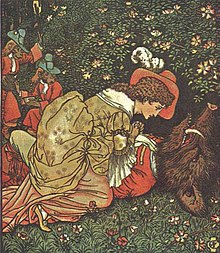
Beauty and the Beast (French: La Belle et la Bête) is a traditional fairy tale written by French novelist Gabrielle-Suzanne Barbot de Villeneuve and published in 1740 in La Jeune Américaine et les contes marins (The Young American and Marine Tales). Her lengthy version was abridged, rewritten, and published first by Jeanne-Marie Leprince de Beaumont in 1756 in Magasin des enfants (Children's Collection), and by Andrew Lang in the Blue Fairy Book of his Fairy Book series in 1889, to produce the version(s) most commonly retold. It was influenced by some earlier stories, such as "Cupid and Psyche," written by Lucius Apuleius Madaurensi in The Golden Ass in the 2nd century AD, and "The Pig King," an Italian fairytale published by Giovanni Francesco Straparola in The Facetious Nights of Straparola.


Volcano
A volcano is a rupture in the crust of a planetary-mass object, such as Earth, that allows hot lava, volcanic ash, and gases to escape from a magma chamber below the surface.
Earth's volcanoes occur because its crust is broken into 17 major, rigid tectonic plates that float on a hotter, softer layer in its mantle.Therefore, on Earth, volcanoes are generally found where tectonic plates are diverging or converging, and most are found underwater. For example, a mid-oceanic ridge, such as the Mid-Atlantic Ridge, has volcanoes caused by divergent tectonic plates pulling apart; the Pacific Ring of Fire has volcanoes caused by convergent tectonic plates coming together. Volcanoes can also form where there is stretching and thinning of the crust's interior plates[clarify], e.g., in the East African Rift and the Wells Gray-Clearwater volcanic field and Rio Grande Rift in North America. This type of volcanism falls under the umbrella of "plate hypothesis" volcanism. Volcanism away from plate boundaries has also been explained as mantle plumes. These so-called "hotspots", for example Hawaii, are postulated to arise from upwelling diapirs with magma from the core–mantle boundary, 3,000 km deep in the Earth. Volcanoes are usually not created where two tectonic plates slide past one another.


Cain and Abel
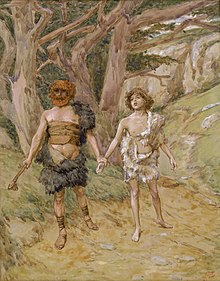
Cain and Abel were sons of Adam and Eve. Cain, the firstborn, tilled the soil, and his brother Abel was a shepherd. The brothers made sacrifices to God, each of his own produce, but God favored Abel's sacrifice instead of that of Cain. Cain murdered Abel. God punished Cain to a life of wandering, but set a mark on him so that no man would kill him. Cain then dwelt in the land of Nod (נוד, "wandering"), where he built a city and fathered the line of descendants beginning with Enoch. The narrative never explicitly states Cain's motive (though it does describe him as being wrathful, and his motive is traditionally assumed to be envy), nor God's reason for rejecting Cain's sacrifice, nor details on the identity of Cain's wife. Some traditional interpretations consider Cain to be the originator of evil, violence, or greed.

My Sister's Keeper
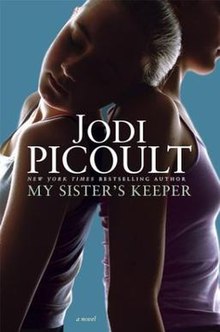
My Sister's Keeper is a 2004 novel written by Jodi Picoult. It tells the story of 13-year-old Anna, who sues her parents for medical emancipation when she is expected to donate a kidney to her sister Kate, who is dying from leukemia.

website: https://www.youtube.com/watch?v=20NY74qxH-I
Jodi Picoult
Jodi Lynn Picoult (/ˈdʒoʊdi piːˈkoʊ/; born May 19, 1966) is an American author. She was awarded the New England Bookseller Award for fiction in 2003. Picoult currently has approximately 14 million copies of her books translated into 34 launguages in print worldwide.

Dionysus
Dionysus (/daɪ.əˈnaɪsəs/; Greek: Διόνυσος, Dionysos) is the god of the grape harvest, winemaking and wine, of ritual madness, fertility, theatre and religious ecstasy in ancient Greek religion and myth. Wine played an important role in Greek culture, and the cult of Dionysus was the main religious focus for its unrestrained consumption. He may have been worshipped as early as c. 1500–1100 BC by Mycenean Greeks; traces of Dionysian-type cult have also been found in ancient Minoan Crete. His origins are uncertain, and his cults took many forms; some are described by ancient sources as Thracian, others as Greek In some cults, he arrives from the east, as an Asiatic foreigner; in others, from Ethiopia in the South. He is a god of epiphany, "the god that comes", and his "foreignness" as an arriving outsider-god may be inherent and essential to his cults. He is a major, popular figure of Greek mythology and religion, becoming increasingly important over time, and included in some lists of the twelve Olympians, as the last of their number, and the only god born from a mortal mother. His festivals were the driving force behind the development of Greek theatre.


Saturn
Saturn (Latin: Saturnus pronounced [saˈtʊr.nʊs]) is a god in ancient Roman religion, and a character in myth. Saturn is a complex figure because of his multiple associations and long history. He was the first god of the Capitol, known since the most ancient times as Saturnius Mons, and was seen as a god of generation, dissolution, plenty, wealth, agriculture, periodic renewal and liberation. In later developments, he also came to be a god of time. His reign was depicted as a Golden Age of plenty and peace. The Temple of Saturn in the Roman Forum housed the state treasury. In December, he was celebrated at what is perhaps the most famous of the Roman festivals, the Saturnalia, a time of feasting, role reversals, free speech, gift-giving and revelry. Saturn the planet and Saturday are both named after the god.

Pietà
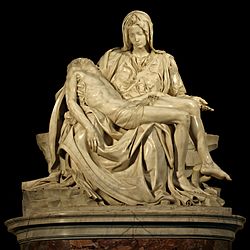
The Pietà (Italian pronunciation: [pjeˈta]) is a subject in Christian art depicting the Virgin Mary cradling the dead body of Jesus, most often found in sculpture. As such, it is a particular form of the Lamentation of Christ, a scene from the Passion of Christ found in cycles of the Life of Christ. When Christ and the Virgin are surrounded by other figures from the New Testament, the subject is strictly called a Lamentation in English, although Pietà is often used for this as well, and is the normal term in Italian.
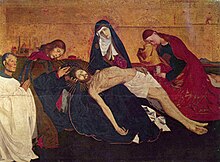
Pietà of Villeneuve-lès-Avignon
Pietà of Villeneuve-lès-Avignon is an oil painting of the mid-15th century that is considered one of the outstanding works of art of the late Middle Ages. Following its appearance at an exhibition in 1904 its authorship was disputed, though it has since been accepted as the work of Enguerrand Quarton. It is now in the Musée du Louvre.
The Pietà, where the dead Christ is supported by his grieving mother, is a common theme of late-medieval religious art, but this is one of the most striking depictions, "perhaps the greatest masterpiece produced in France in the 15th century" (Edward Lucie-Smith). It is distinctive from previous depictions of the subject—which were often characterized by overt displays of grief and trauma—by virtue of its restraint. The composition is stable, with the Virgin's hands together in prayer, rather than clutching the body of Christ. The curved back form of Christ's body is highly original, and the stark, motionless dignity of the other figures is very different from Italian or Netherlandish depictions. The style of the painting is unique for its time: the grouping of the figures appears somewhat primitive, yet the conception evidences both great breadth and delicacy, the latter quality especially evident in the specificity of the portraits and the elegant gesture of St. John's hands at Christ's head.

Saint Francis of Assisi
Saint Francis of Assisi (Italian: San Francesco d'Assisi), born Giovanni di Pietro di Bernardone, informally named as Francesco (1181/1182 – 3 October 1226), was an Italian Roman Catholic friar, deacon and preacher. He founded the men's Order of Friars Minor, the women’s Order of Saint Clare, the Third Order of Saint Francis and the Custody of the Holy Land. Francis is one of the most venerated religious figures in history.


Hydrometer
A hydrometer or areometer is an instrument that measures the specific gravity (relative density) of liquids—the ratio of the density of the liquid to the density of water.
A hydrometer is usually made of glass, and consists of a cylindrical stem and a bulb weighted with mercury or lead shot to make it float upright. The liquid to test is poured into a tall container, often a graduated cylinder, and the hydrometer is gently lowered into the liquid until it floats freely. The point at which the surface of the liquid touches the stem of the hydrometer correlates to specific gravity. Hydrometers usually contain a scale inside the stem, so that the person using it can read specific gravity. A variety of scales exist for different contexts.


website: https://www.youtube.com/watch?v=jNVePBvI2ps
Lord of the Flies
Lord of the Flies is a 1954 novel by Nobel Prize-winning English author William Golding. The book focuses on a group of British boys stranded on an uninhabited island and their disastrous attempt to govern themselves.
Published in 1954, Lord of the Flies was Golding's first novel. Although it was not a great success at the time—selling fewer than three thousand copies in the United States during 1955 before going out of print—it soon went on to become a best-seller. It has been adapted to film twice in English, in 1963 by Peter Brook and 1990 by Harry Hook, and once in Filipino (1976).
The book takes place in the midst of an unspecified nuclear war. Some of the marooned characters are ordinary students, while others arrive as a musical choir under an established leader. With the exception of the choirboys, Sam, and Eric, they appear never to have encountered each other before. The book portrays their descent into savagery; left to themselves on a paradisiacal island, far from modern civilization, the well-educated children regress to a primitive state.
Golding wrote his book as a counterpoint to R.M. Ballantyne's youth novel The Coral Island, and included specific references to it, such as the rescuing naval officer's description of the children's pursuit of Ralph as "a jolly good show, like the Coral Island". Golding's three central characters—Ralph, Piggy and Jack—have been interpreted as caricatures of Ballantyne's Coral Island protagonists.


