H.G.Wells
Herbert George "H. G." Wells(21 September 1866 – 13 August 1946) was an English writer. He was prolific in many genres, including the novel, history, politics, social commentary, and textbooks and rules for war games. Wells is now best remembered for his science fiction novels and is called a "father of science fiction", along with Jules Verne and Hugo Gernsback. His most notable science fiction works include The Time Machine (1895), The Island of Doctor Moreau (1896), The Invisible Man (1897), and The War of the Worlds (1898). He was nominated for the Nobel Prize in Literature four times.

Science fiction
Science fiction is a genre of speculative fiction, typically dealing with imaginative concepts such as futuristic science and technology, space travel, time travel, faster than light travel, parallel universes, and extraterrestrial life. Science fiction often explores the potential consequences of scientific and other innovations, and has been called a "literature of ideas." It usually avoids the supernatural, and unlike the related genre of fantasy, historically science-fiction stories were intended to have a grounding in science-based fact or theory at the time the story was created, but this connection is now limited to hard science fiction.

The Time Machine
The Time Machine is a science fiction novel by H. G. Wells, published in 1895 and written in 1897 as a frame narrative. Wells is generally credited with the popularization of the concept of time travel by using a vehicle that allows an operator to travel purposely and selectively forwards or backwards in time. The term "time machine", coined by Wells, is now almost universally used to refer to such a vehicle.
The Time Machine has been adapted into three feature films of the same name, as well as two television versions, and a large number of comic book adaptations. It has also indirectly inspired many more works of fiction in many media productions.

Extraterrestrial life
Extraterrestrial life, also called alien life (or, if it is a sentient or relatively complex individual, an "extraterrestrial" or "alien"), is life that does not originate from Earth. These hypothetical life forms may range from simple single-celled organisms to beings with civilizations far more advanced than humanity. Although many scientists expect extraterrestrial life to exist in some form, there is no evidence for its existence to date. The Drake equation speculates about the existence of intelligent life elsewhere in the universe. The science of extraterrestrial life in all its forms is known as exobiology.



Pacifism
Pacifism is opposition to war, militarism, or violence. The word pacifism was coined by the French peace campaigner Émile Arnaud (1864–1921) and adopted by other peace activists at the tenth Universal Peace Congress in Glasgow in 1901.[1] A related term is ahimsa (to do no harm), which is a core philosophy in Buddhism, Jainism, and Hinduism. While modern connotations are recent, having been explicated since the 19th century, ancient references abound.


Pornography
Pornography is the portrayal of sexual subject matter for the purpose of sexual arousal. Pornography may be presented in a variety of media, including books, magazines, postcards, photographs, sculpture, drawing, painting, animation, sound recording, writing, film, video, and video games. The term applies to the depiction of the act rather than the act itself, and so does not include live exhibitions like sex shows and striptease. The primary subjects of present-day pornographic depictions are pornographic models, who pose for still photographs, and pornographic actors or porn stars, who perform in pornographic films. If dramatic skills are not involved, a performer in a porn film may also be called a model.

Obscenity
An obscenity is any utterance or act that strongly offends the prevalent morality of the time. It is derived from the Latin obscaena (offstage) a cognate of the Ancient Greek root skene, because some potentially offensive content, such as murder or sex, was depicted offstage in classical drama. The word can be used to indicate a strong moral repugnance, in expressions such as "obscene profits" or "the obscenity of war".

D.H.Lawrence
David Herbert Lawrence (11 September 1885 – 2 March 1930) was an English novelist, poet, playwright, essayist, literary critic and painter. His collected works represent, among other things, an extended reflection upon the dehumanising effects of modernity and industrialisation. Some of the issues Lawrence explores are sexuality, emotional health, vitality, spontaneity, and instinct.

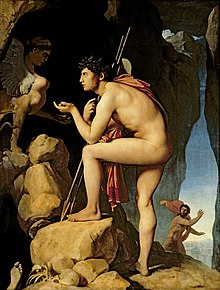
Oedipus complex
In psychoanalysis, the Oedipus complex (or, less commonly, Oedipal complex) is a child's desire, that the mind keeps in the unconscious via dynamic repression, to have sexual relations with the parent of the opposite sex (i.e. males attracted to their mothers).
The Oedipus complex occurs in the third—phallic stage (ages 3–6)—of the five psychosexual development stages: (i) the oral, (ii) the anal, (iii) the phallic, (iv) the latent, and (v) the genital—in which the source of libidinal pleasure is in a different erogenous zone of the infant's body. The Oedipal complex originally refers to the sexual desire of a son for his mother and does not need to be reciprocated.

Electra complex
In Neo-Freudian psychology, the Electra complex, as proposed by Carl Gustav Jung, is a girl's psychosexual competition with her mother for possession of her father. In the course of her psychosexual development, the complex is the girl's phallic stage; formation of a discrete sexual identity, a boy's analogous experience is the Oedipus complex. The Electra complex occurs in the third—phallic stage (ages 3–6)—of five psychosexual development stages: (i) the Oral, (ii) the Anal, (iii) the Phallic, (iv) the Latent, and (v) the Genital—in which the source libido pleasure is in a different erogenous zone of the infant’s body.


Penis envy
Penis envy (German: Penisneid) is a stage theorized by Sigmund Freud regarding female psychosexual development, in which young girls experience anxiety upon realization that they do not have a penis. Freud considered this realization a defining moment in a series of transitions toward a mature female sexuality and gender identity. In Freudian theory, the penis envy stage begins the transition from an attachment to the mother to competition with the mother for the attention, recognition and affection of the father.[1]The parallel reaction of a boy's realization that women do not have a penis is castration anxiety.
The Rocking-Horse Winner
"The Rocking-Horse Winner" is a short story by D. H. Lawrence. It was first published in July 1926, in Harper's Bazaar and subsequently appeared in the first volume of Lawrence's collected short stories. It was made into a full-length film directed by Anthony Pelissier and starring John Howard Davies, Valerie Hobson and John Mills; the film was released in the United Kingdom in 1949 and in 1950 in the United States.

Essay on The Rocking-Horse Winner


沒有留言:
張貼留言