Lord of the Flies
Lord of the Flies is a 1954 novel by Nobel Prize-winning English author William Golding. The book focuses on a group of British boys stranded on an uninhabited island and their disastrous attempt to govern themselves.
At an allegorical level, the central theme is the conflicting human impulses toward civilization and social organization—living by rules, peacefully and in harmony—and toward the will to power. Themes include the tension between groupthink and individuality, between rational and emotional reactions, and between morality and immorality. How these play out, and how different people feel the influences of these form a major subtext of Lord of the Flies.


website: https://www.youtube.com/watch?v=CX4vZflew_A
William Golding
Sir William Gerald Golding CBE (19 September 1911 – 19 June 1993) was an English novelist, playwright, and poet. Best known for his novel Lord of the Flies, he won a Nobel Prize in Literature, and was also awarded the Booker Prize for fiction in 1980 for his novel Rites of Passage, the first book in what became his sea trilogy, To the Ends of the Earth.
Golding was knighted in 1988. He was a fellow of the Royal Society of Literature. In 2008, The Times ranked Golding third on their list of "The 50 greatest British writers since 1945".

Hierarchy
A hierarchy (from the Greek hierarchia, "rule of a high priest", from hierarkhes, "leader of sacred rites") is an arrangement of items (objects, names, values, categories, etc.) in which the items are represented as being "above," "below," or "at the same level as" one another.
A hierarchy is a system or organization in which people or groups are ranked one above the other according to status or authority.


Top 10 Commencement Speeches
These are truly inspirational graduation speeches worth reading from the beginning to the end. It is not easy to select just 10 speeches. Truth be told, I love each and every commencement address I collected on this site, now over 200 of them. I believe you can't go wrong with any of these graduation speeches; there is something to learn and share from every single commencement speech.
1.Steve Jobs
 Your time is limited, so don't waste it living someone else's life. Don't let the noise of others' opinions drown out your own inner voice. And most important, have the courage to follow your heart and intuition. Remembering that you are going to die is the best way I know to avoid the trap of thinking you have something to lose. You are already naked. There is no reason not to follow your heart."
2. David Foster Wallace
Is extremely difficult to stay alert and attentive, instead of getting hypnotized by the constant monologue inside your own head (may be happening right now). Twenty years after my own graduation, I have come gradually to understand that the liberal arts cliché about teaching you how to think is actually shorthand for a much deeper, more serious idea: learning how to think really means learning how to exercise some control over how and what you think.
website: http://www.graduationwisdom.com/speeches/topten.htm
Joyce Carol Oates
Joyce Carol Oates (born June 16, 1938) is an American writer. Oates published her first book in 1963 and has since published over 40 novels, as well as a number of plays and novellas, and many volumes of short stories, poetry, and nonfiction. She has won many awards for her writing, including the National Book Award, for her novel them (1969), two O. Henry Awards, and the National Humanities Medal. Her novels Black Water (1992), What I Lived For (1994), Blonde (2000), and short story collections The Wheel of Love (1970) and Lovely, Dark, Deep: Stories (2014) were each finalists for the Pulitzer Prize.

The Handmaid's Tale
The Handmaid's Tale is a 1985 dystopian novel by Canadian author Margaret Atwood. Set in a near-future New England, in a totalitarian theocracy that has overthrown the United States government, the novel explores themes of women in subjugation and the various means by which they gain individualism and independence. The novel's title echoes the component parts of Geoffrey Chaucer's The Canterbury Tales, which comprises a series of connected stories ("The Merchant's Tale", "The Parson's Tale", etc.).

website: http://www.salon.com/2017/05/20/handmaids-tale-hulu-trump-saudi-arabia/
Margaret Atwood
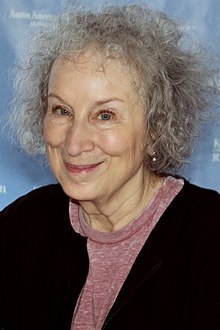
Margaret Eleanor Atwood, CC OOnt FRSC (born November 18, 1939) is a Canadian poet, novelist, literary critic, essayist, and environmental activist. She is a winner of the Arthur C. Clarke Award and Prince of Asturias Award for Literature, has been shortlisted for the Booker Prize five times, winning once, and has been a finalist for the Governor General's Award several times, winning twice. In 2001, she was inducted into Canada's Walk of Fame. She is also a founder of the Writers' Trust of Canada, a non-profit literary organization that seeks to encourage Canada's writing community. Among innumerable contributions to Canadian literature, she was a founding trustee of the Griffin Poetry Prize.
Courage
Courage (also called bravery or valour) is the choice and willingness to confront agony, pain, danger, uncertainty, or intimidation. Physical courage is bravery in the face of physical pain, hardship, death or threat of death, while moral courage is the ability to act rightly in the face of popular opposition, shame, scandal, discouragement, or personal loss.
The classical virtue of fortitude (andreia, fortitudo) is also translated "courage", but includes the aspects of perseverance and patience.
Virtue
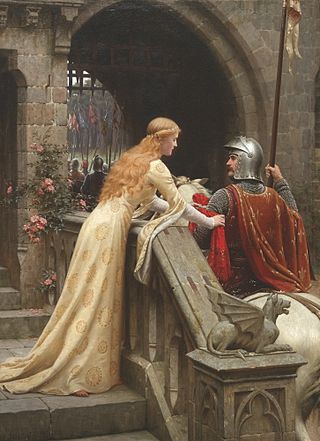
Virtue (Latin: virtus, Ancient Greek: ἀρετή "arete") is moral excellence. A virtue is a trait or quality that is deemed to be morally good and thus is valued as a foundation of principle and good moral being. Personal virtues are characteristics valued as promoting collective and individual greatness. The opposite of virtue is vice.
The four classic cardinal virtues are:temperance, prudence, courage, and justice. Christianity derives the three theological virtues of faith, hope and love (charity) from 1 Corinthians. Together these make up the seven virtues. Buddhism's four brahmavihara ("Divine States") can be regarded as virtues in the European sense. The Japanese Bushidō code is characterized by up to ten virtues, including rectitude, courage, and benevolence.

Charge of the Light Brigade
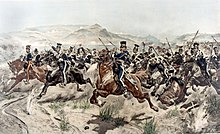
The Charge of the Light Brigade was a charge of British light cavalry led by Lord Cardigan against Russian forces during the Battle of Balaclava on 25 October 1854, in the Crimean War. Lord Raglan, overall commander of the British forces, had intended to send the Light Brigade to prevent the Russians removing captured guns from overrun Turkish positions, a task well-suited to light cavalry. However, due to miscommunication in the chain of command, the Light Brigade was instead sent on a frontal assault against a different artillery battery, one well-prepared with excellent fields of defensive fire.

Lord Cardigan
Lieutenant General James Thomas Brudenell, 7th Earl of Cardigan KCB (16 October 1797 – 28 March 1868) was an officer in the British Army who commanded the Light Brigade during the Crimean War. He led the Charge of the Light Brigade at the Battle of Balaclava.

Beelzebub
Beelzebub or Beelzebul is a name derived from a Philistine god, formerly worshipped in Ekron, and later adopted by Abrahamic religions as a given name to a winged demon. The name Beelzebub is associated with the Canaanite god Baal.
In theological sources, predominately Christian, Beelzebub is another name for the devil similar to Satan. He is known by believers as one of the seven princes of Hell, according to Catholic views in terms of demonology. The Dictionnaire Infernal describes Beelzebub as a being capable of flying, known as the "Lord of the Flyers", or the "Lord of the Flies".


Satan
Satan is a figure appearing in the texts of the Abrahamic religionswho brings evil and temptation, and is known as the deceiver who leads humanity astray. Some religious groups teach that he originated as an angel, or something of the like, who used to possess great piety and beauty, but fell because of hubris, seducing humanity into the ways of falsehood and sin, and has power in the fallen world. In the Hebrew Bible and the New Testament, Satan is primarily an accuser and adversary, a decidedly malevolent entity, also called the devil, who possesses abhorrent qualities.


Testament of Solomon
The Testament of Solomon is an Old Testament pseudepigraphical work ascribed to King Solomon. It was written in the Greek language, some time in the early 1st millennium CE. It describes how Solomon was enabled to build his temple by commanding demons by means of a magical ring that was entrusted to him by the archangel Michael.


Mephistopheles
Mephistopheles is a demon featured in German folklore. He originally appeared in literature as the demon in the Faust legend, and he has since appeared in other works as a stock character.


Erinyes
In Greek mythology the Erinyes also known as the Furies, were female chthonic deities of vengeance; they were sometimes referred to as "infernal goddesses" (χθόνιαι θεαί). A formulaic oath in the Iliad invokes them as "the Erinyes, that under earth take vengeance on men, whosoever hath sworn a false oath". Walter Burkert suggests they are "an embodiment of the act of self-cursing contained in the oath". They correspond to the Dirae in Roman mythology. The Roman writer Maurus Servius Honoratus wrote that they are called "Eumenides" in hell, "Furiae" on earth, and "Dirae" in heaven.


Electra
In Greek mythology, Elektra (/ᵻˈlɛktrə/; Greek: Ἠλέκτρα, Ēlektra "amber") was the daughter of King Agamemnon and Queen Clytemnestra, and thus princess of Argos. She and her brother Orestes plotted revenge against their mother Clytemnestra and stepfather Aegisthus for the murder of their father.


沒有留言:
張貼留言