Henry Wadsworth Longfellow
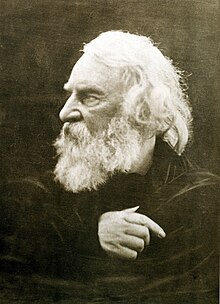
Henry Wadsworth Longfellow was an American poet and educator whose works include "Paul Revere's Ride", The Song of Hiawatha, and Evangeline. He was also the first American to translate Dante Alighieri's Divine Comedy, and was one of the five Fireside Poets.
Longfellow was born in Portland, Maine, which was then a part of Massachusetts. He studied at Bowdoin College. After spending time in Europe he became a professor at Bowdoin and, later, at Harvard College. His first major poetry collections were Voices of the Night (1839) and Ballads and Other Poems (1841). Longfellow retired from teaching in 1854, to focus on his writing, living the remainder of his life in Cambridge, Massachusetts, in a former Revolutionary War headquarters of George Washington. His first wife Mary Potter died in 1835, after a miscarriage. His second wife Frances Appleton died in 1861, after sustaining burns when her dress caught fire. After her death, Longfellow had difficulty writing poetry for a time and focused on translating works from foreign languages. He died in 1882.
Paul Revere's Ride
"Paul Revere's Ride" (1860) is a poem by American poet Henry Wadsworth Longfellow that commemorates the actions of American patriot Paul Revere on April 18, 1775, although with significant inaccuracies. It was first published in the January 1861 issue of The Atlantic Monthly. It was later retitled "The Landlord's Tale" in the collection Tales of a Wayside Inn.

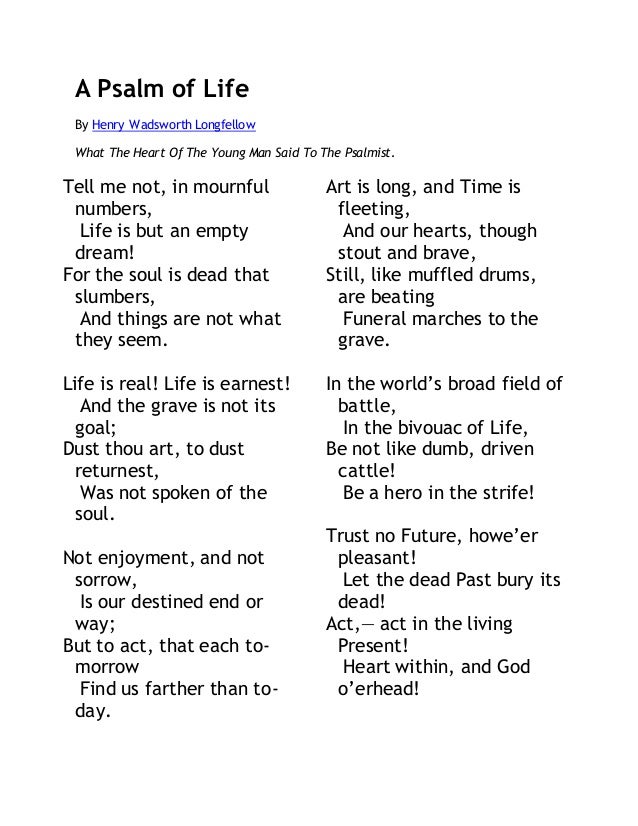
A Psalm of Life
"A Psalm of Life" is a poem written by American writer Henry Wadsworth Longfellow, often subtitled "What the Heart of the Young Man Said to the Psalmist".
The poem, written in an ABAB pattern, is meant to inspire its readers to live actively, and neither to lament the past nor to take the future for granted. The didactic message is underscored by a vigorous trochaic meter and frequent exclamation. Answering a reader's question about the poem in 1879, Longfellow himself summarized that the poem was "a transcript of my thoughts and feelings at the time I wrote, and of the conviction therein expressed, that Life is something more than an idle dream." Richard Henry Stoddard referred to the theme of the poem as a "lesson of endurance".

Tomorrow and tomorrow and tomorrow
Tomorrow and tomorrow and tomorrow is the beginning of the second sentence of one of the most famous soliloquies in Shakespeare's tragedy Macbeth. It takes place in the beginning of the 5th scene of Act 5, during the time when the English troops, led by Malcolm and Macduff, are approaching Macbeth's castle to besiege it. Macbeth, the play's protagonist, is confident that he can withstand any siege from Malcolm's forces. He hears the cry of a woman and reflects that there was a time when his hair would have stood on end if he had heard such a cry, but he is now so full of horrors and slaughterous thoughts that it can no longer startle him.
She should have died hereafter;
There would have been a time for such a word.
— To-morrow, and to-morrow, and to-morrow,
Creeps in this petty pace from day to day,
To the last syllable of recorded time;
And all our yesterdays have lighted fools
The way to dusty death. Out, out, brief candle!
Life's but a walking shadow, a poor player
That struts and frets his hour upon the stage
And then is heard no more. It is a tale
Told by an idiot, full of sound and fury
Signifying nothing.
— Macbeth (Act 5, Scene 5, lines 17-28)
There would have been a time for such a word.
— To-morrow, and to-morrow, and to-morrow,
Creeps in this petty pace from day to day,
To the last syllable of recorded time;
And all our yesterdays have lighted fools
The way to dusty death. Out, out, brief candle!
Life's but a walking shadow, a poor player
That struts and frets his hour upon the stage
And then is heard no more. It is a tale
Told by an idiot, full of sound and fury
Signifying nothing.
— Macbeth (Act 5, Scene 5, lines 17-28)
website: https://www.youtube.com/watch?v=4LDdyafsR7g
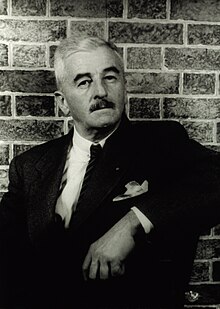
William Faulkner
William Cuthbert Faulkner (/ˈfɔːlknər/, September 25, 1897 – July 6, 1962) was an American writer and Nobel Prize laureate from Oxford, Mississippi. Faulkner wrote novels, short stories, a play, poetry, essays, and screenplays. He is primarily known for his novels and short stories set in the fictional Yoknapatawpha County, based on Lafayette County, Mississippi, where he spent most of his life.
Faulkner is one of the most celebrated writers in American literature generally and Southern literature specifically. Though his work was published as early as 1919, and largely during the 1920s and 1930s, Faulkner was relatively unknown until receiving the 1949 Nobel Prize in Literature, for which he became the only Mississippi-born Nobel winner. Two of his works, A Fable (1954) and his last novel The Reivers (1962), won the Pulitzer Prize for Fiction. In 1998, the Modern Library ranked his 1929 novel The Sound and the Fury sixth on its list of the 100 best English-language novels of the 20th century; also on the list were As I Lay Dying (1930) and Light in August (1932). Absalom, Absalom! (1936) is often included on similar lists.
william faulkner's nobel prize acceptance speech
Faulkner's speech was short. He introduces his main point at the beginning of the second paragraph.
Our tragedy today is a general and universal physical fear so long sustained by now that we can even bear it.
He was speaking in 1950. The Cold War between the United States and the U.S.S.R. had begun. Both sides were building more and more atomic weapons. The U.S.S.R. was building enormous long-range missiles to deliver the atomic warheads anywhere in America. The U.S. had short-range missiles pointed at the U.S.S.R. from bases in Europe and elsewhere, as well as bombing planes based within easy striking distance of the Soviet cities and military targets. Everyone in the world could see that the two superpowers would soon have enough bombs to blow up the entire world and wipe out the human race. Faulkner said:
There is only one question: When will I be blown up?
website: https://www.youtube.com/watch?v=gOg30JBnik8
Because I could not stop for Death
"Because I could not stop for Death" is a lyrical poem by Emily Dickinson first published posthumously in Poems: Series 1 in 1890. The persona of Dickinson's poem meets personified Death. Death is a gentleman caller who takes a leisurely carriage ride with the speaker to her grave. According to Thomas H. Johnson's variorum edition of 1955 the number of this poem is 712.


Edgar Allan Poe
Edgar Allan Poe was an American writer, editor, and literary critic. Poe is best known for his poetry and short stories, particularly his tales of mystery and the macabre. He is widely regarded as a central figure of Romanticism in the United States and American literature as a whole, and he was one of the country's earliest practitioners of the short story. Poe is generally considered the inventor of the detective fiction genre and is further credited with contributing to the emerging genre of science fiction. He was the first well-known American writer to try to earn a living through writing alone, resulting in a financially difficult life and career.
Romanticism
Romanticism was an artistic, literary, musical and intellectual movement that originated in Europe toward the end of the 18th century and in most areas was at its peak in the approximate period from 1800 to 1850. Romanticism was characterized by its emphasis on emotion and individualism as well as glorification of all the past and nature, preferring the medieval rather than the classical. It was partly a reaction to the Industrial Revolution,the aristocratic social and political norms of the Age of Enlightenment, and the scientific rationalization of nature - all components of modernity. It was embodied most strongly in the visual arts, music, and literature, but had a major impact on historiography, education, and the natural sciences. It had a significant and complex effect on politics, and while for much of the Romantic period it was associated with liberalism and radicalism, its long-term effect on the growth of nationalism was perhaps more significant.


The Tell-Tale Heart
"The Tell-Tale Heart" is a short story by Edgar Allan Poe first published in 1843. It is told by an unnamed narrator who endeavors to convince the reader of his sanity, while describing a murder he committed. The victim was an old man with a filmy "vulture-eye", as the narrator calls it. The murder is carefully calculated, and the murderer hides the body by dismembering it and hiding it under the floorboards. Ultimately, the narrator's feelings of guilt, or a mental disturbance, result in him hearing the dead man's beating heart.
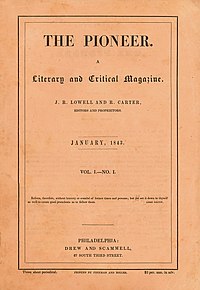
The story was first published in James Russell Lowell's The Pioneer in January 1843. "The Tell-Tale Heart" is widely considered a classic of the Gothic fiction genre and is one of Poe's most famous short stories.


沒有留言:
張貼留言